Intercompany balances
Check that what one group company owes, charges or earns from another is booked the same way on both sides, and eliminate the matched pairs.
On this page
When one group company lends to, invoices or rents to another, both companies book it — one as a receivable or revenue, the other as a payable or cost. In the group's figures both sides must disappear. Intercompany balances lines up the two sides of every company pair, shows where they differ, and lets you eliminate them. Nothing is changed in either company's books.
Getting there
Companies → Intercompany balances. Admins and editors use it; in a demo group viewers can read it too.
Choosing what to check
| Filter | Meaning |
|---|---|
| Fiscal year, Through period | Balance-sheet accounts at the end of the period; P&L accounts year to date. |
| Scope | Whole group, or a saved scope — then only pairs whose two companies are both in it. |
| Basis | Adjusted (books + adjustments) or Statutory (books only). |
The summary line
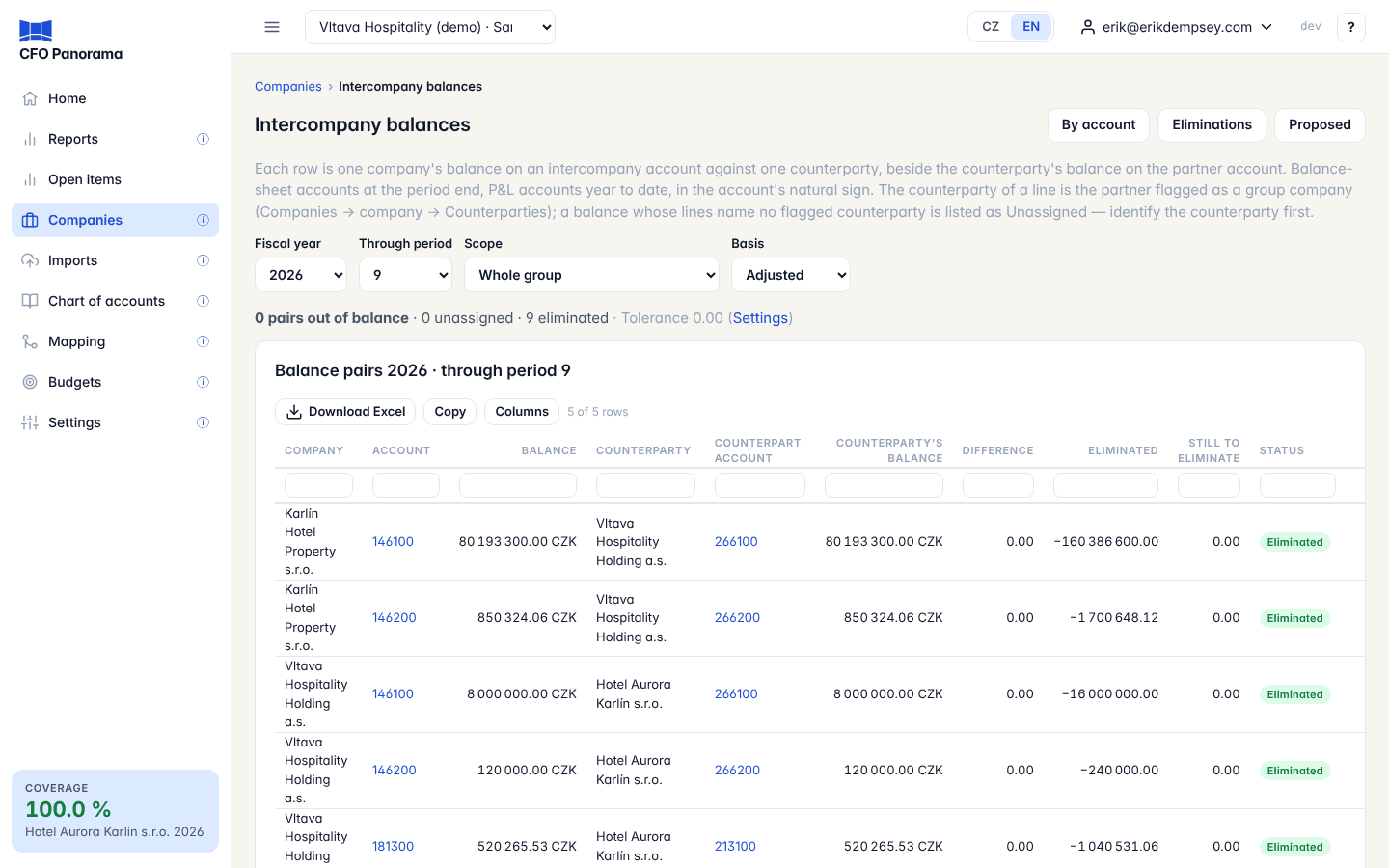
At the top: how many pairs are out of balance and by how much in total, how many balances are unassigned, how many pairs are eliminated, and the Tolerance.
The pairs
The page has two tables: Balance pairs (receivables, payables, loans) and Flow pairs (revenue and costs). Each row is one company's balance on an intercompany account against one counterparty, beside the counterparty's balance on the partner account:
Company, Account, Balance · Counterparty, Counterpart account, Counterparty's balance · Difference · Eliminated · Still to eliminate · Status.
| Status | Meaning |
|---|---|
| Unassigned | Lines on an intercompany account name no partner flagged as a group company. Click identify the counterparty (see Counterparties). |
| One-sided | Only one company has booked it. |
| Difference | Both have booked it, but the amounts differ by more than the tolerance; the row says which side is lower and by how much. |
| Matched | Both sides agree within the tolerance; ready to eliminate. |
| Rule | A fee the buyer capitalises, eliminated by an unrealised-profit rule (see Eliminations). |
| Eliminated | An elimination has been posted and nothing is left. |
Where the two companies book in different currencies, the pair is shown in the presentation currency; a difference that is only the month's exchange-rate movement is labelled FX and counts as matched — a translation effect, not a booking error.
Drill to the lines
The account codes are links: each opens that company's journal lines on the account for the period, filtered to the counterparty, so you can see which invoice or payment is missing.
Eliminating
The worksheet by account
By account (or Companies → Intercompany) shows the same information account by account: each intercompany Global account with its partner accounts, every company's balance, the total, and Left to eliminate (both sides). Before an elimination is posted, "left to eliminate" adds both sides together — twice the journal's amount; once it is posted it is 0.00. A second table lists the lines booked against group partners, flagging lines on an account that is not an intercompany account. The link … eliminations proposed for this month → Proposed opens the month's proposals.
Good to know
- Out-of-balance pairs also appear as a notice on the report and in the board pack's evidence slide.
- Closing a month lists the pairs still out of balance inside the scope.
Did not find what you need? Write to erik@cfopanorama.com.