Eliminations
The journals that remove intercompany balances and flows from the group's figures — proposed for you, posted per pair, and kept per ledger for the whole group and each scope.
On this page
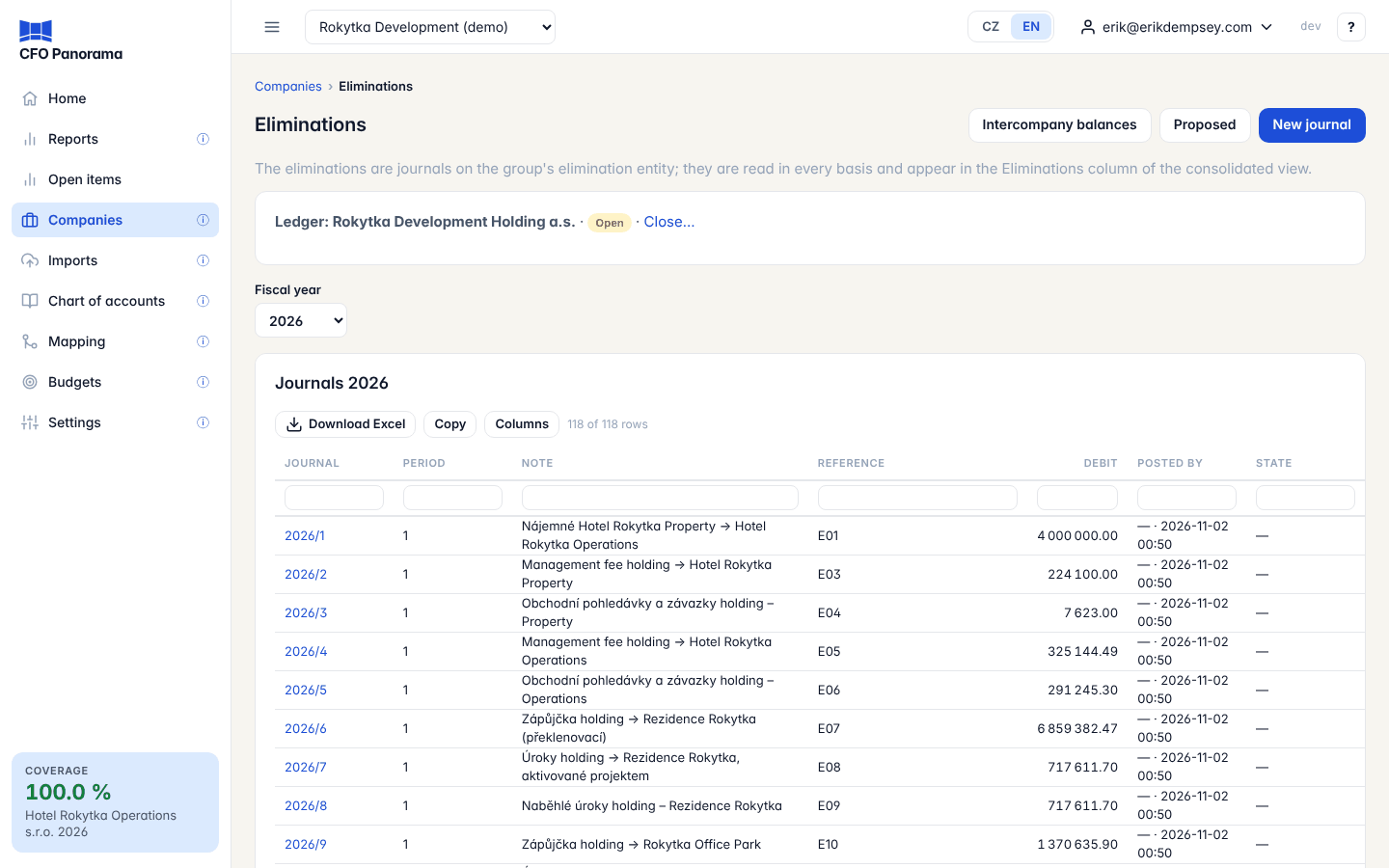
Eliminations remove what group companies owe, charge and earn from each other, so the consolidated figures show only the group's dealings with the outside world. They are journals on a separate elimination entity of the group — never in a company's books. They appear in the Eliminations column of a consolidated report and are read on both bases (books only and books + adjustments).
Getting there
Companies → Eliminations. Admins and editors can open it. Viewers see the result in the reports.
The journal list
Choose the Fiscal year. The Journals table lists every elimination journal: Journal (its number, e.g. 2026/14), Period, Note, Reference, Debit, Posted by and State — reversal, reversed by …, locked period (posted into a locked month) or home changed since lock.
Click a journal number for its detail: ledger, period, rate anchor, its Lines, and the Audit trail.
Proposed eliminations
Each month CFO Panorama works out what should be eliminated, per pair of companies and accounts, from the intercompany balances. Proposed shows the month's list: Reference, Pair (the two companies and accounts), Note, Amount, Kind — recurring (posted before, same reference and note), new, or unrealised profit — and Source (the import that produced it, or the worksheet).
The list is recomputed whenever you open it, so a late import gives a proposal for the difference. One-sided or unassigned balances are not proposed.
A new journal by hand
- Fill in Fiscal year, Period, an optional Reference and the Note (required).
- On every line choose the Company whose balance the line eliminates, then the Global account, an optional Description, and the Debit or Credit. The account list shows intercompany accounts only; tick Show all accounts (not only the intercompany ones) for the rest. Add line adds rows; empty rows are ignored.
- Watch the panel under the lines: Total debit, Total credit, Remaining to balance (Balanced, or the amount missing on one side and which company is short) and Per company with what each company still has to eliminate after this journal.
- The Rate anchor matters only when the group reports in another currency: Period end (default), Date (for example a dividend's declaration date — fill in Rate date) or Counterpart company (the company's own historical rate, for capital consolidation).
- Click Post.
A two-line elimination — a payable of one company against the receivable of the other — is valid: it balances in total and removes both sides. If the same reference is already posted in the month you are asked to confirm; if the month is locked, tick Post into a locked period to post anyway (the report then flags the difference).
Reversing a journal
A posted journal never changes. To correct one, an admin opens it and, under Reverse this journal, chooses the fiscal year and period (the same or later) and a note, then clicks Reverse. The reversal posts the same lines with debit and credit swapped; the original stays, marked reversed by ….
Unrealised profit rules
When one company charges another fees that the buyer capitalises — for example construction management in a development project — part of the asset's cost is the seller's own profit. A rule handles this every month: it proposes one elimination for the year-to-date fees — the fee revenue out, the seller's own costs in as own work capitalised, and the asset reduced by the margin.
Multi-level eliminations and ledgers
A report of a scope or of a holding with everything it owns takes only the elimination journals whose companies are all inside it. A journal between a company inside and one outside is left out, and that balance shows as a related party.
Each journal has a home ledger: the lowest company that owns all the companies it names, or Group level. When journals live in two or more ledgers, the page shows a tab per ledger and All. The ledger line shows its lock state (Open or Locked through …), its open proposals, any journals posted after the lock, and Close… (see Closing a month). After a change of ownership the homes are updated automatically, except in locked months.
Troubleshooting
- "Row n: choose the company whose balance on … this line eliminates." — every line needs a Company.
- "…companies have different fiscal calendars" or "…different functional currencies" — eliminations cannot be posted for this group yet.
Did not find what you need? Write to erik@cfopanorama.com.